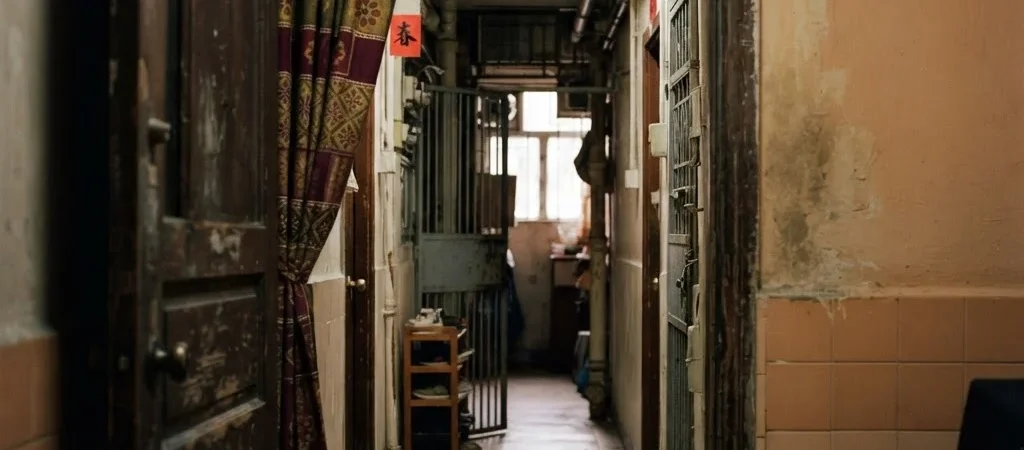
A hallway is rarely just a hallway in In the Mood for Love. It is a narrow passage shared by neighbors, a place to exchange a few words, and a frame that keeps Chow Mo-wan and Su Li-zhen just out of reach of the open world. Wong Kar-wai’s film makes that closeness feel both ordinary and impossible.
The frame keeps a distance
Set in 1962 Hong Kong, the film follows Chow and Su as they realize their spouses are having an affair with each other. Their connection grows through repeated encounters and conversation, but the camera often watches from behind a doorway or through a crowded interior. We see enough to feel their proximity, never enough to mistake it for freedom.
That visual distance gives the film its particular pressure. The close rooms and shared corridors make small gestures legible: a pause before entering, a glance held a beat too long, the careful handling of a meal. The images are lush, but they are not merely decoration; the beautiful surfaces keep reminding us how little space these characters have.
Repetition changes the moment
The film returns to familiar routes and encounters rather than pushing toward a series of revelations. Su’s patterned dresses, the rain-dark streets, and the repeated musical passages give the story a pulse that feels like habit becoming memory. A scene can echo an earlier one and still land differently, because we now understand what the characters are choosing not to say.
The score’s recurring waltz can make those returns feel almost suspended, while the cramped interiors keep the story grounded in daily life. That balance is why the film’s restraint does not read as emptiness to me. The unspoken parts have texture: embarrassment, care, and the knowledge that an imagined future is not the same as a shared one.
After the credits
In the Mood for Love does not need a grand declaration to make its emotional stakes clear. Its final movement shifts the scale from rooms and corridors toward time, distance, and what a person carries away alone. The film leaves space around its ending instead of explaining what every image should mean.
What stays with me is how carefully the film looks at the space between people. It offers a useful reminder that composition is not only about what enters the frame; it is also about the doorway, shadow, or wall that keeps something partially hidden. After the credits, those thresholds are what I remember.